0-1
Booking Platform
Search
CMS
Web

Dylan Styles Design
Completed 2023
Let's talk about the journey, not the destination
Jump to a section and learn more.
Project context
Framing the projects problem space, design process and how I measured success.
Client
Urban Rest
Team
Delivery Lead
Engineering Manager
Product Design Lead
5x Developers
Client Partner
Duration
6 months
Impact
Web booking platform
+36% Bookings
+34% User engagement
Digital roadmap
What's the problem?
Problem space
With rapid growth, their digital functions quickly became a weak point.
The original Wordpress site struggled to facilitate bookings, champion their brand and wasn't scaleable.
Their digital maturity was in it's early stages, with no clear roadmap to support growth.
The premium service standard came at a high operational cost that wasn't sustainable,
0-1 product design
Inventing and delivering a concept that turns uncertainty into a fit for market minimum viable product.
Listen
Look
Think
Make
Measuring success
Success for this product means driving property bookings through an overall more engaging and effective booking platform.
Increase booking conversion
Elevate conversion metrics through an overhauled e2e booking flow.
Offload operational cost
Reduce the dependency on Urban Rests customer service teams through alternate problem resolution paths.
Reduce discovery drop-off
Alleviating drop-off at key parts of the user flow.
Increase content engagement
Improve average session time, pages per session, click through.
Journey mapping
How I identified the key areas of opportunity.
With multiple audiences and differing requirements, I mapped out their individual pain points across the customer journey.
Doing this surfaced where digital could add the most value to the customer experience, ultimately leading to the two part experience solution.
Brand Discovery
Opportunity Area
Direct bookers
Booking, managing and staying with UR.
Business account
Directly communicating with UR account managers.
OUT OF UR CONTROL
Retail & GDS
External channels that move control away from UR.
Lead-gen & Awareness
Low awareness of who UR are
High commission (10-15%)
Highly competitive
Value Proposition
Unclear of why customers should choose UR
No visibility of brand
Authentication & Preferences
No incentive to become a member/sign up to marketing comms
No visibility of premium product offering
Booking Experience
Search
No availability shown
No price indication
Non specific property and location info
Unclear language
Slow back and forth process
OUT OF UR CONTROL
Diluted by massive market
Compare & Choose
Details shown don't appeal to primary, long term audience
Hard to compare between properties
Poor photography
Up & Cross-sell
Can't add products/add-ons to properties
Manual process with ops team
Slow response time
OUT OF UR CONTROL
Low/no opportunity to upsell
Payment
Unable to transfer between roles - employee > business account holder
Delayed - Invoice required to start payment process
Other Transactional
Volume/sequence of info is confusing
Commission charged on transaction
Stay Experience
Check-in & Identification
House manual access not intuitive
Break in brand/experience fluidity
essential check in information is heavy and easily missed
Ratio (ID verification platform) is difficult/heavy
Third party guest ID out of UR control
Accessing Property
Access type is inconsistent across properties
Changes to arrival time sometimes doesn't flow through to cs
Property Knowledge/Info
House manual access is confusing
Lifestyle and location information unavailable
Hard to find local attractions and essentials
Problem Resolution
Minimal help to rely on before resorting to direct customer service calls
High margin for human error
Comms lost between channels, guest and UR
Varying needs of different channels
Slow resolution due to middle man wall
Local Information
House manual and local area info visibility
In-stay Upsell
No platform for offering upsell/making the guest aware of options
OUT OF UR CONTROL
Blocked by third party rules
Check-out
Guests not aware of check-out rules and is a low priority to them
Operational issues with lost keys etc
Post Stay
Follow-up Feedback
Unlikely to complete unless there's an issue
OUT OF UR CONTROL
Feedback can be directed towards the retail channel and not UR
Retention & Re-book
Purely relying on the customer returning based on their stay
No benefits/loyalty
No guarantee of brand visibility
Multi-stage digital experience
1 of 2
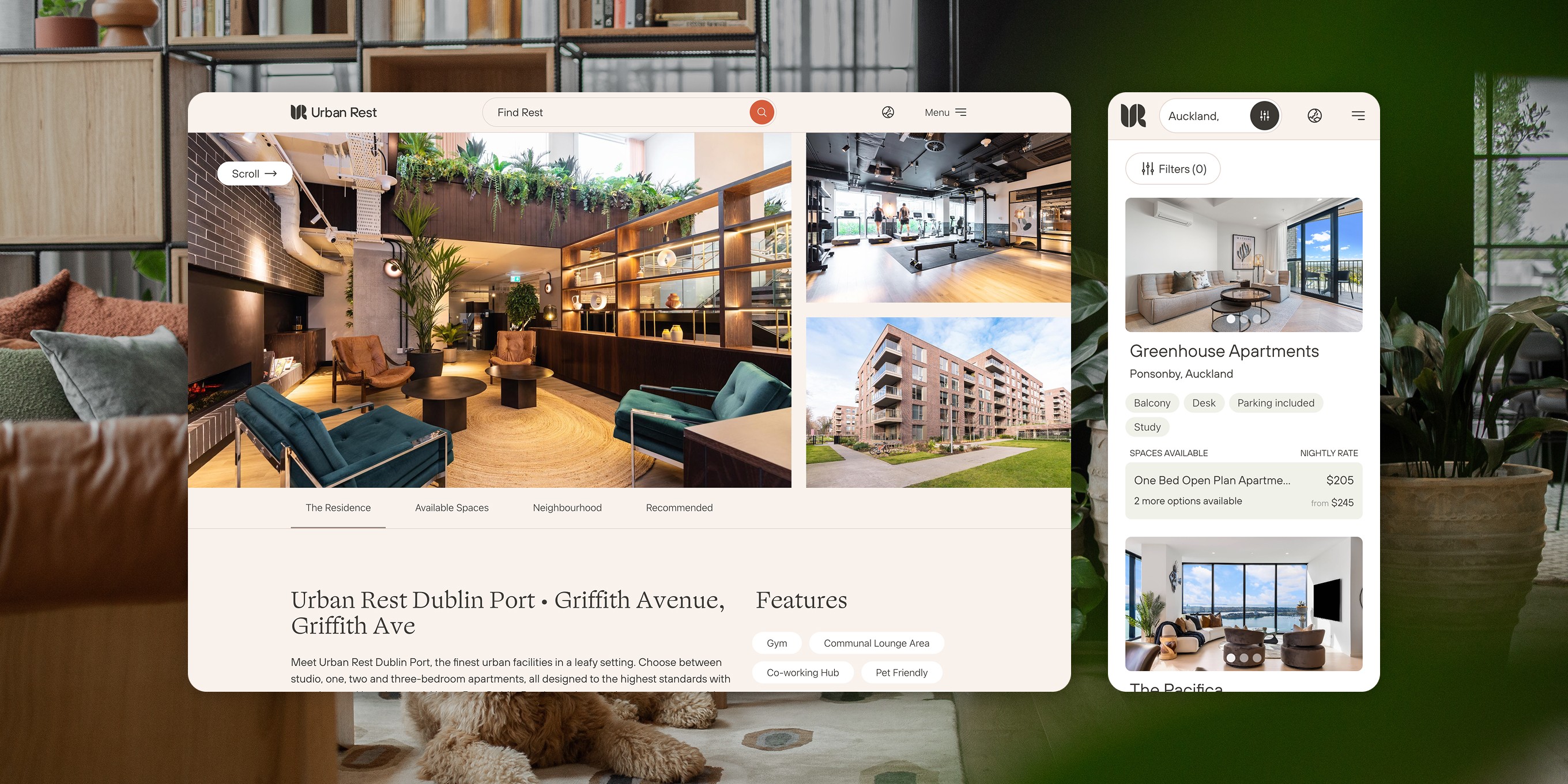
The web experience
Creating a premium branded home for Urban Rest's new and return customers. Servicing the brand discovery and booking experience for direct and business bookers with the following features:
Brand discovery & value proposition
Search, comparison & booking
Location & property information
Streamlined online check-in
Location led IA
Through user research I learned our audience were travelling to a specific city for a reason (usually work), so we structured the IA to direct traffic to relevant, tailored city content - launching them into search functionality at a suburb/lifestyle level.
Home Directory
New users
City Page
Organic/non-organic
Localised Search
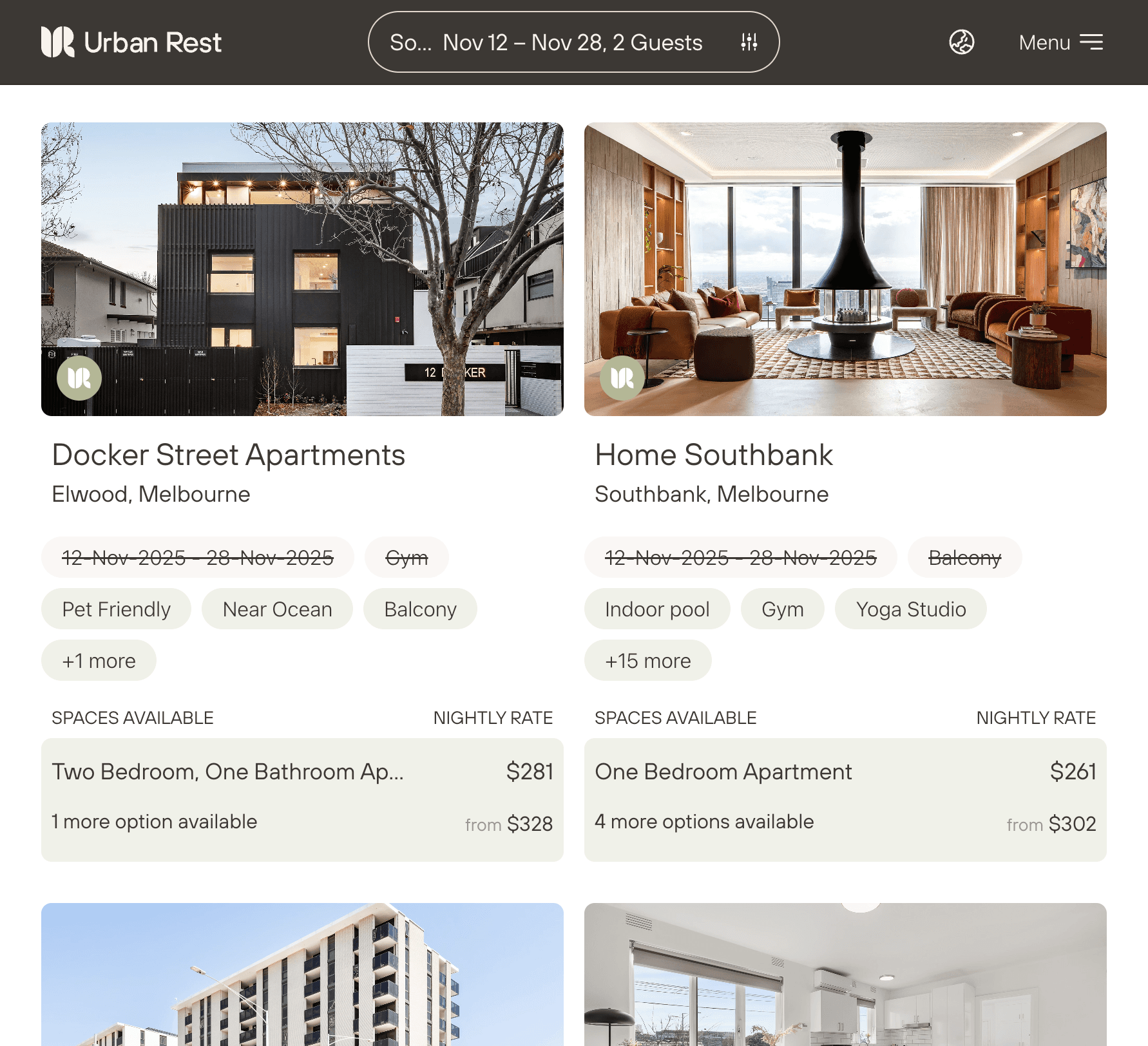
Similar but different search results
Between limited property availability, long term occupancy and flexible audience requirements I flipped the secondary search results to show what the property doesn't have.
Using the search and filter inputs - the results surface what's not included to allow the user to weigh their options easily.
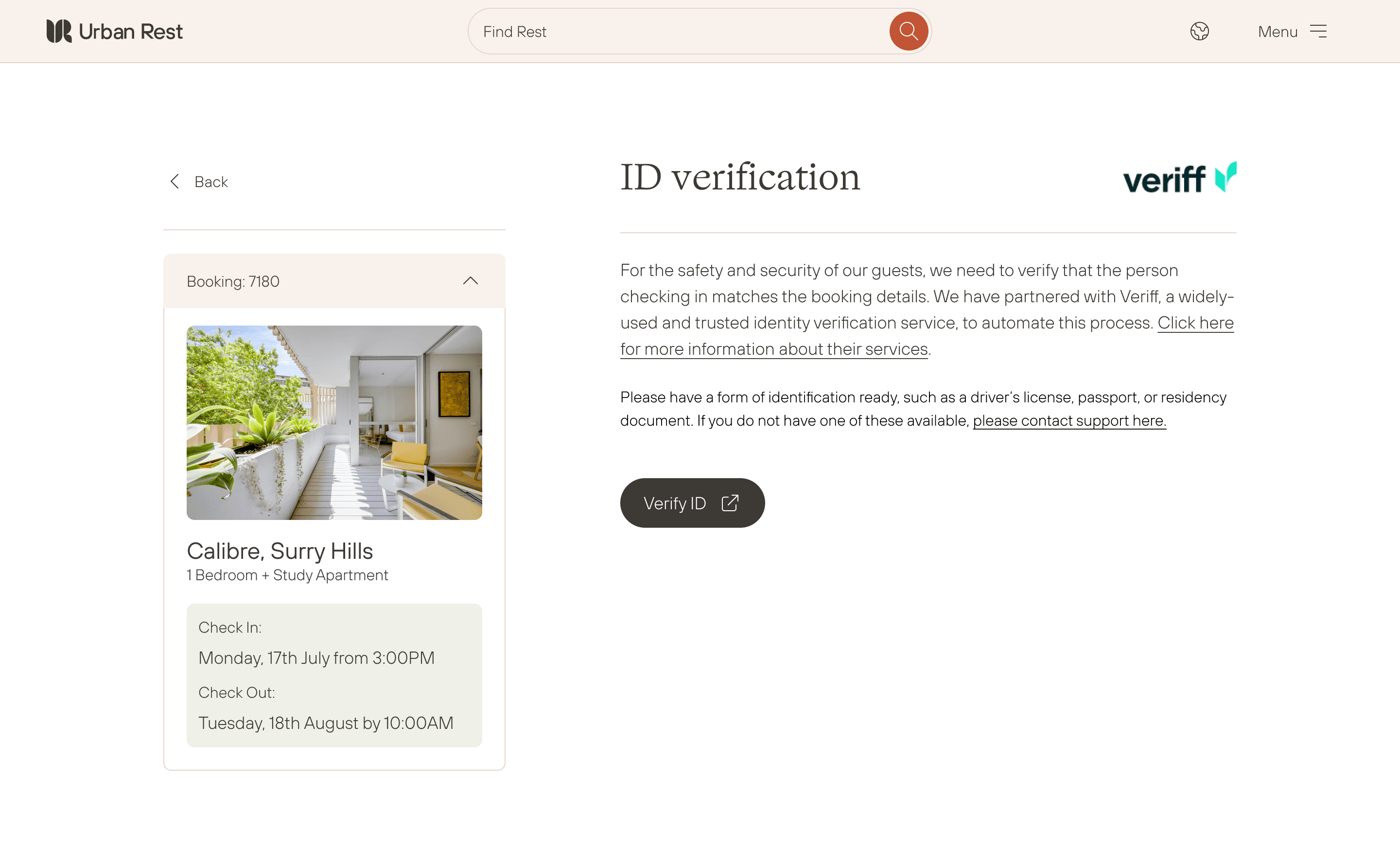
Streamlined and secure online check-in
Offering a branded, secure way for users to check-in smoothly from an email link and providing essential details for their stay.
Multi-stage digital experience
2 of 2
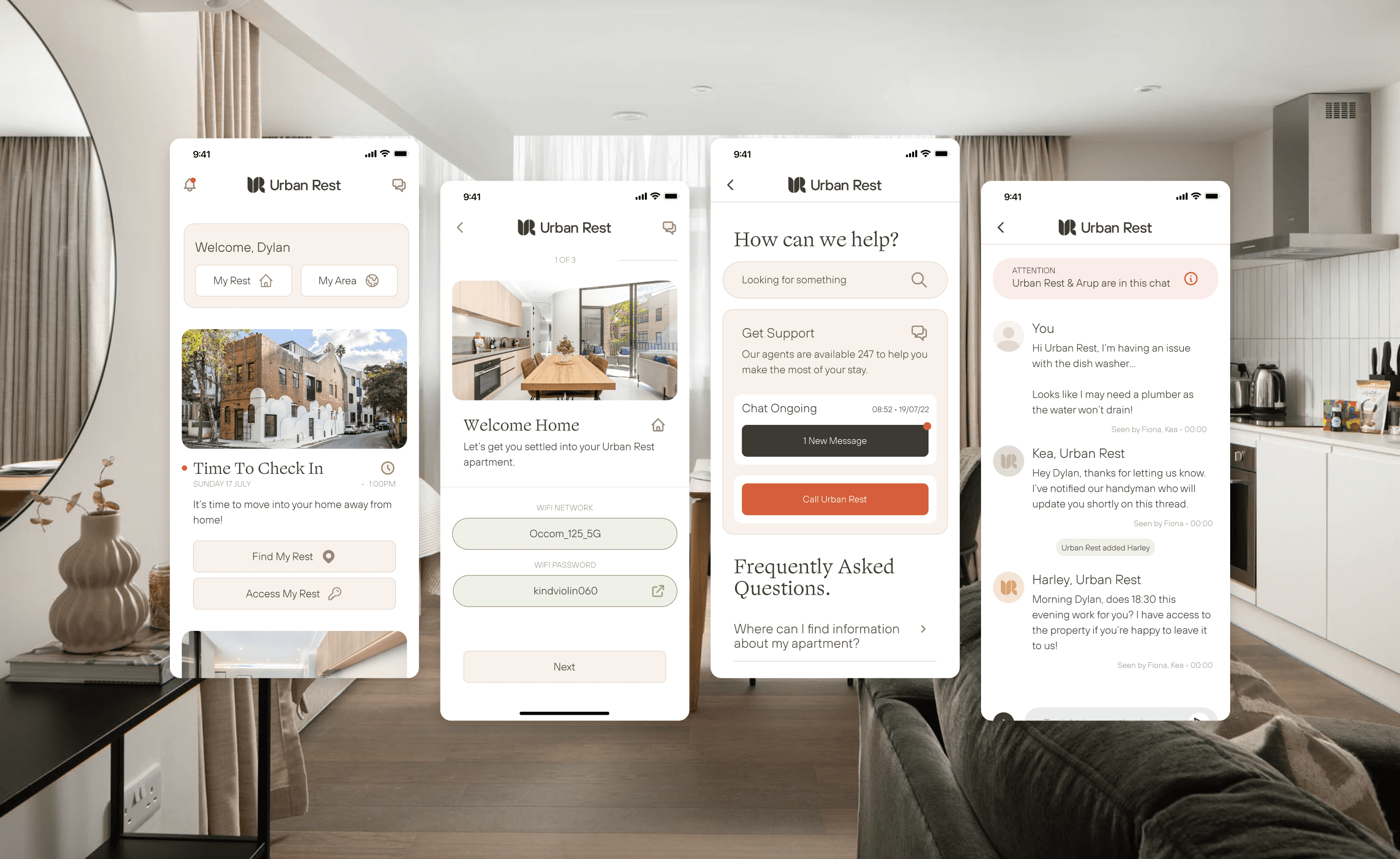
The in-stay app
Picking up from online check-in, users are invited to their in stay companion which is tailored to their location, lifestyle and expectation of service.
Location & property access
Property onboarding & amenities
Problem resolution
Local knowledge
What I'd do differently next time.
Validating assumptions
I was confident in users basing their exploration on a POI such as their office, a conference centre or suburb - assuming the search tool would be the primary discovery method.
In reality users spent more time exploring city landing pages and discovering suburbs and properties through content rather than the more rigorous search tool.
Although I was confident in user intentions and behaviours, which early user research lead us to — I didn't seek validation of our design execution through user testing.
Building on solid foundations
Excited about the 'Similar but different' search concept, it was easy to focus on an innovative feature, its potential and how we can deliver it. I overlooked the fact we were building search functionality from scratch, which is complex in itself.
Prioritising core functionality builds a solid foundation for future iterations — meeting users expectations, then exceeding them.
Strategically saving context and ideas for later
With so much thinking spread across mediums like Miro, Figma, slack and docs — not to mention product management tools like ClickUp. I found it hard to reference back to specifics, making it difficult to build more concrete design rational for stakeholders. Especially coming back to the project for feature enhancements.
Investing time early to capture product requirements and feature definitions unlocks future Dylan's opportunity to add value.